
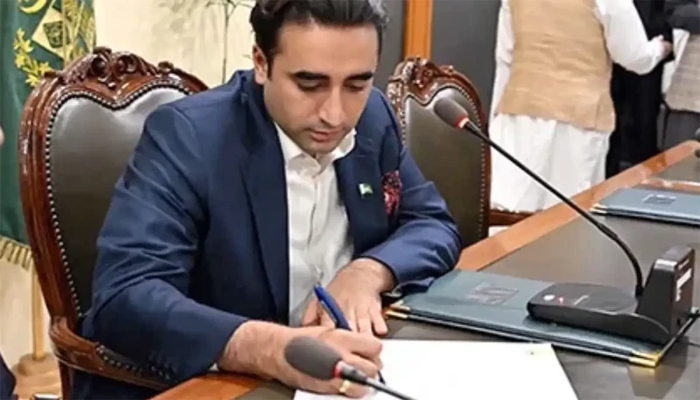
ISLAMABAD: Pakistan Peoples Party (PPP) Chairman Bilawal Bhutto-Zardari has stated that the federal government has not contacted him or President Asif Ali Zardari regarding any proposed 28th Constitutional Amendment, despite growing media speculation about constitutional changes in Pakistan.
Speaking at a press conference after chairing a PPP parliamentary party meeting at the Parliament House in Islamabad on Thursday, he clarified that while communication exists with Prime Minister Shehbaz Sharif on broader national issues, no formal consultation has been initiated on constitutional amendments.
Bilawal emphasized that without the PPP’s support, major parliamentary actions such as constitutional amendments and the federal budget process would face difficulty, highlighting the party’s importance in Pakistan political news developments.
He said the PPP has consistently supported the government on national matters including security, economic stability, and foreign policy Pakistan priorities, referencing tensions with India and Iran-US relations where the party backed the federal stance.
On the Pakistan economy crisis and upcoming federal budget Pakistan 2026 discussions, Bilawal said the economic situation is worsening and the government must adopt relief-oriented measures while considering public hardships.
Regarding NAB amendments Pakistan, he reiterated PPP’s long-standing stance on abolishing the National Accountability Bureau but said the party supported recent amendments due to governmental constraints, warning that PPP may reconsider if commitments are not met.
He added that a senior PPP committee including Raja Pervaiz Ashraf, Sherry Rehman, Saleem Mandviwalla, and Naveed Qamar will submit budget proposals to the government.
Bilawal further stated that Prime Minister Shehbaz Sharif and Field Marshal Asim Munir are making efforts for regional peace, especially concerning Iran-US tensions, and stressed that Pakistan foreign policy is being shaped in national interest.
He said PPP remains engaged with the government on national consensus issues and will continue to play its role in parliamentary cooperation amid ongoing political and economic challenges.