
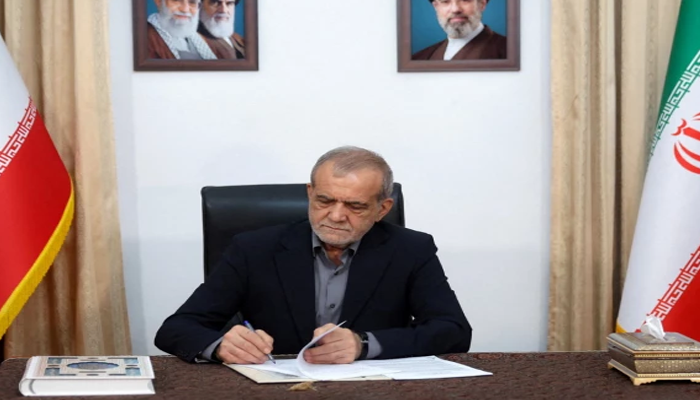
TEHRAN: Iranian President Masoud Pezeshkian has revealed that the country’s late Supreme Leader Ali Khamenei had repeatedly urged an end to the prolonged state of “no war, no peace” between Iran and the United States, as military tensions continue to intensify across the Middle East.
Speaking at a ceremony marking National Industry and Mining Day, Pezeshkian said Khamenei had consistently emphasized in private meetings the importance of ending the prolonged uncertainty in Iran-US relations. According to Iran’s official IRNA news agency, the president said Tehran entered negotiations with Washington while safeguarding the country's “honour, wisdom and dignity” and vowed that Iran’s diplomatic institutions would continue defending the rights of the Iranian people.
The remarks come amid a rapidly escalating regional conflict involving Iran, the United States and several Gulf nations. Iran’s Islamic Revolutionary Guard Corps (IRGC) claimed it launched the 24th wave of Operation Nasr 2, targeting a complex housing US forces in Jordan’s Al-Rukban area. The IRGC alleged that several American soldiers were killed, although neither US nor Jordanian authorities immediately confirmed the claim.
The IRGC also claimed responsibility for strikes on a US military base in Bahrain and alleged it targeted data infrastructure linked to Amazon in the Gulf kingdom. The claims have not been independently verified, and neither Bahrain nor Amazon has issued an official response.
Meanwhile, Gulf countries strongly condemned the latest Iranian attacks. The United Arab Emirates described the strikes on Bahrain, Kuwait and Jordan as a violation of sovereignty and reaffirmed its support for regional security. Bahrain activated air raid sirens multiple times and reported intercepting several incoming missiles and drones, while Jordan said its air defence systems successfully neutralised five Iranian drones.
Kuwait also reported renewed Iranian strikes on critical power generation and desalination facilities, with authorities confirming fires at multiple sites. Emergency crews extinguished the blazes, and assessments of the damage are ongoing.
In another significant development, Iran reiterated that the Strait of Hormuz would remain closed as long as US military operations continue. Iranian media quoted military sources as saying Tehran would maintain control over the strategic waterway until security conditions improve, raising concerns about global oil supplies and international shipping.
Separately, the UK Maritime Trade Operations (UKMTO) reported that a commercial vessel was struck by an unidentified projectile off the coast of the United Arab Emirates, damaging its steering system. All crew members were reported safe, and investigations into the incident are underway.
The growing conflict has prompted international concern, with the Association of Southeast Asian Nations (ASEAN) calling for maximum restraint and an immediate end to hostilities. The bloc warned that continued military escalation threatens diplomatic efforts to restore peace in the region.
Diplomatic initiatives led by Pakistan and Qatar remain active, with reports indicating fresh proposals aimed at securing a temporary ceasefire and restarting negotiations between Tehran and Washington. However, continued military exchanges have kept the region on edge, leaving the prospects for de-escalation uncertain.