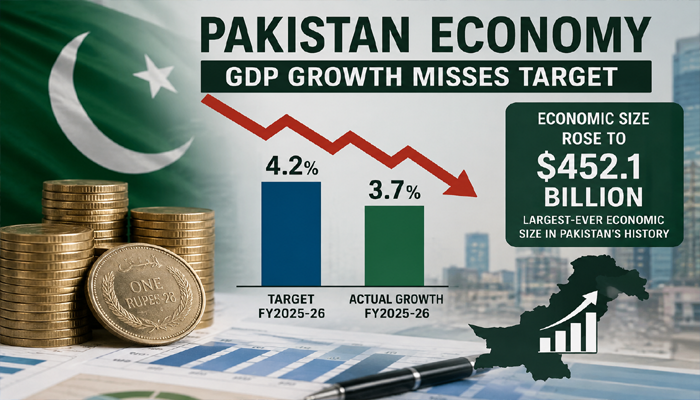
ISLAMABAD: Pakistan’s economy recorded growth of 3.7 percent during fiscal year 2025-26, falling short of the government’s target of 4.2 percent, according to the Economic Survey 2025-26 released ahead of the federal budget announcement.
Finance Minister Muhammad Aurangzeb presented the survey on Thursday and outlined the country’s economic performance during the outgoing fiscal year. Despite missing the official growth target, Pakistan achieved an economic size of $452.1 billion, marking the largest economy in the country’s history in terms of overall value.
The latest GDP growth figures reflect a year shaped by external economic and regional challenges. According to the finance minister, several unexpected developments affected Pakistan’s economic momentum and limited the pace of expansion.
Speaking during the briefing, Aurangzeb said Pakistan entered FY2025-26 facing global trade uncertainty linked to international tariff discussions. However, he noted that by the end of July the country had improved its competitive position in export markets, especially exports to the United States.
The finance minister also pointed to floods and regional tensions that emerged later in the fiscal year as major external pressures on economic activity. He described these developments as exogenous factors that created obstacles for growth across multiple sectors.
Attention also remained focused on Pakistan’s ongoing discussions with the International Monetary Fund regarding budgetary targets and economic policy measures. Responding to questions about progress in negotiations, Aurangzeb said talks with the IMF were continuing and moving in a positive direction.
Economic analysts believe that while the economy did not achieve the planned growth rate, maintaining positive GDP expansion under challenging circumstances signals a degree of resilience. The government is expected to focus on fiscal reforms, export growth, investment support, and economic stability in the upcoming federal budget.
The Economic Survey also sets the stage for key policy announcements expected in the national budget, where attention will remain on inflation management, development spending, tax measures, and continued engagement with international financial institutions.
Pakistan’s economic outlook for the next fiscal year will largely depend on reforms, investor confidence, and the outcome of IMF negotiations.