
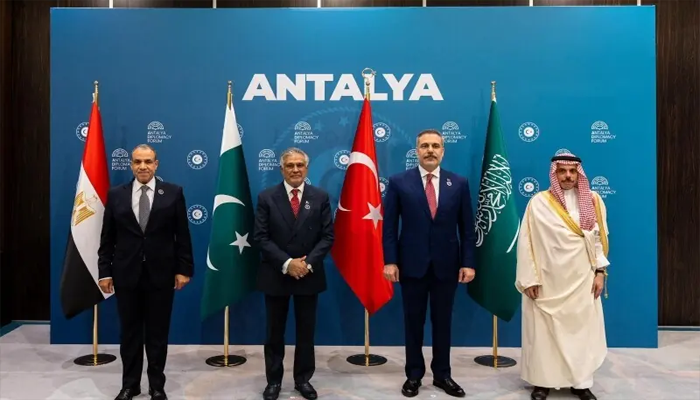
ANTALYA: Foreign ministers from Pakistan, Saudi Arabia, Turkiye and Egypt met to discuss rapidly evolving regional developments and ongoing diplomatic efforts to ease tensions in the Middle East. The meeting took place on the sidelines of the Antalya Diplomacy Forum, where leaders emphasized dialogue and cooperation amid the ongoing US-Iran crisis.
Pakistan’s Deputy Prime Minister and Foreign Minister Ishaq Dar joined Saudi Foreign Minister Faisal bin Farhan, Turkiye’s Foreign Minister Hakan Fidan, and Egypt’s Foreign Minister Badr Abdelatty. According to officials, the leaders exchanged views on regional security, reaffirming the importance of diplomacy in maintaining peace and stability.
The talks come after a series of high-level meetings aimed at preventing escalation in the US-Israel-Iran conflict. Earlier discussions were held in Riyadh and Islamabad before a temporary ceasefire agreement, which is set to expire on April 22. The four countries have been actively coordinating efforts to prevent further conflict and ensure stability across the region.
Pakistan has played a key diplomatic role by hosting direct talks between Iran and the United States earlier this month. While the negotiations did not result in a formal agreement, both sides avoided a breakdown, raising hopes for continued engagement. Reports suggest that a second round of US-Iran talks in Islamabad may take place soon.
Egyptian Foreign Minister Abdelatty highlighted that Cairo is working closely with Islamabad to develop a framework for long-term peace between Washington and Tehran. He noted that the joint efforts by Pakistan, Saudi Arabia, Turkiye and Egypt are focused on reducing tensions and building a post-war regional security structure.
The ministers also stressed the importance of protecting Gulf countries and ensuring stability in global energy markets, supply chains and food security. With oil prices and shipping routes under pressure due to ongoing tensions, regional cooperation remains critical.
As diplomatic momentum builds, the coordinated approach by these key nations could play a crucial role in shaping the future of Middle East peace efforts and preventing further escalation.