

BEJING: China has set a new national benchmark in space communication by successfully achieving a peak satellite-to-ground laser transmission speed of 120 gigabits per second (Gbps). The milestone was reached in a commercial experiment conducted by the Aerospace Information Research Institute (AIR) under the Chinese Academy of Sciences.
The experiment demonstrated a stable and high-quality communication link, with data transmission rates exceeding 100 Gbps and flawless downlink performance. This achievement builds on AIR’s earlier successes of 10 Gbps in 2023 and 60 Gbps in 2025, highlighting rapid progress in China’s operational laser communication capabilities.
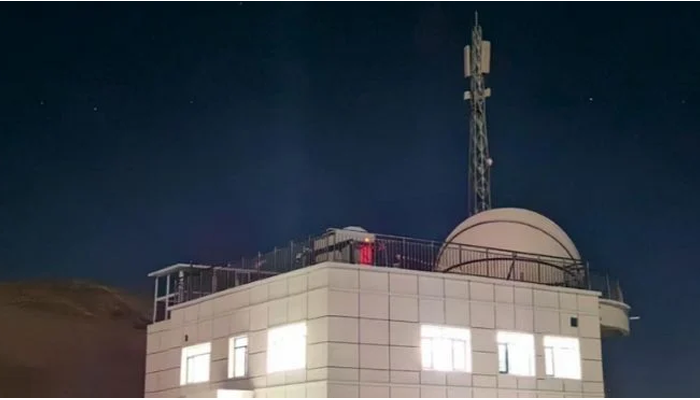
During the test, the communication capacity of the AIRSAT-02 satellite’s laser payload was doubled from 60 Gbps to 120 Gbps through on-orbit software optimization, without any physical modifications to the satellite. The experiment relied on a domestically developed laser communication system with a 500-millimeter aperture, installed at a ground station located on the Pamir Plateau in Xinjiang’s Uyghur Autonomous Region.
The breakthrough sets a new domestic record for satellite-to-ground laser communication speed and overcomes key technical challenges, including rapid link establishment, stable long-duration operation, and reliable high-efficiency data transfer.
According to researchers, the satellite and ground station established a communication link within seconds, achieving a success rate of over 93 percent. The longest continuous connection lasted 108 seconds, during which 12.656 terabits of data were transmitted. High-quality remote sensing images were successfully received and processed by the end of the operation.
Notably, the ground station used in the experiment is China’s first commercial and routinely operated satellite-to-ground laser communication facility. Operational since September 2024, it has already supported multiple space missions.
Experts say satellite-to-ground laser communication is regarded as the most effective method for ultra-high-speed transmission of large volumes of space-based data. Continued operational validation suggests the technology is now mature enough to support future large-scale space data downlinks.