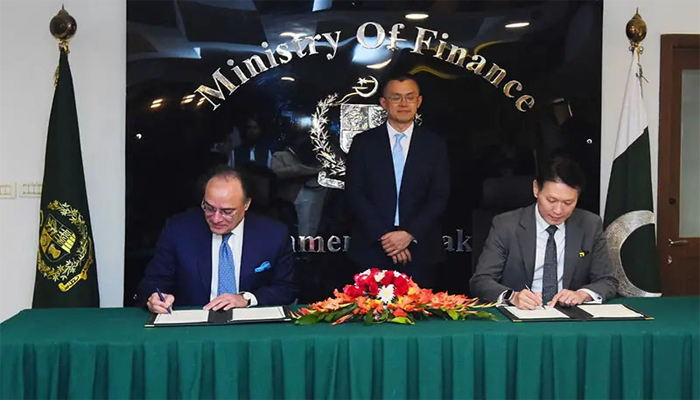
KARACHI: Pakistan has taken a major step toward integrating digital assets into its financial system by signing a memorandum of understanding with global crypto exchange Binance to explore the tokenisation of up to $2 billion worth of sovereign bonds, treasury bills and government-owned commodity reserves. The development, announced by the finance ministry in Karachi on December 12, marks a significant shift in the country’s approach to blockchain-based finance and regulated crypto markets.
According to the ministry, the agreement aims to assess how real-world assets such as sovereign bonds, T-bills and commodity reserves including oil, gas and metals can be converted into digital tokens and distributed through blockchain platforms. Tokenisation allows physical or traditional financial assets to be represented digitally, improving liquidity, transparency and access for both domestic and international investors.
In a parallel move, Pakistan has also granted initial regulatory clearances to Binance and digital-asset platform HTX to establish a formal presence in the country. The Pakistan Virtual Assets Regulatory Authority, or PVARA, confirmed that it has issued No Objection Certificates to both exchanges. These approvals allow the companies to begin preparatory steps such as registering under anti-money laundering frameworks, setting up local subsidiaries and preparing applications for full exchange licences.
Finance Minister Muhammad Aurangzeb described the agreement with Binance as a strong signal of Pakistan’s reform-oriented direction and commitment to long-term partnerships in emerging financial technologies. Binance founder Changpeng Zhao welcomed the development, calling it a positive sign for the global blockchain industry and an important milestone for Pakistan’s digital asset ecosystem.
PVARA Chair Bilal bin Saqib said the initial clearances are part of a phased licensing process designed to ensure strong governance, transparency and compliance with international AML and counter-terror financing standards. He noted that exchanges demonstrating robust compliance controls would be better positioned to receive full operating licences in the future.
The initiative places Pakistan alongside countries such as the United Arab Emirates, Japan and several European Union states that are expanding formal regulatory frameworks for crypto exchanges amid tighter global oversight. Officials say the potential $2 billion tokenisation programme, subject to regulatory approvals, could help attract foreign investment and deepen liquidity in Pakistan’s financial markets.
This development is part of a broader digital finance overhaul underway in Pakistan. In recent months, the government has established the Pakistan Crypto Council, created the Virtual Assets Regulatory Authority and accelerated work on a comprehensive licensing regime for digital asset platforms. Authorities have also announced plans for a central bank digital currency pilot and a Virtual Assets Act expected in 2025.
Pakistan already ranks as the world’s third-largest crypto market by retail participation, according to Saqib, highlighting the importance of bringing the sector into a regulated framework. Earlier this year, Pakistan’s crypto council also signed a letter of intent with US-based World Liberty Financial to explore stablecoin usage, tokenisation and other blockchain infrastructure projects.
With these measures, Pakistan is positioning itself as a regulated and innovation-friendly destination for digital finance, aiming to balance investor protection with growth in blockchain-based financial services.