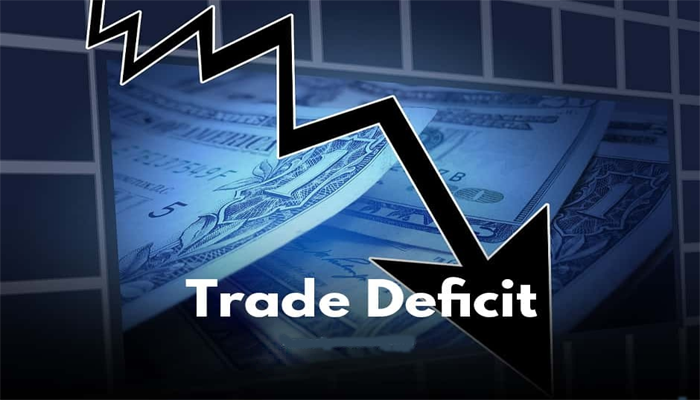
Pakistan’s trade deficit surged significantly in November 2025, highlighting continued pressure on the country’s external sector as both monthly and annual data point toward widening economic imbalances.
According to figures released by the Pakistan Bureau of Statistics (PBS) on Tuesday, the trade deficit increased by nearly 33 percent year-on-year, reaching $2.86 billion compared to $2.15 billion in November 2024.
The latest data shows a sharp decline in Pakistan’s export performance at a time when global markets are gradually stabilizing. Exports dropped to $2.39 billion in November 2025, a steep fall of 15.4 percent compared to $2.83 billion during the same month last year. Industry experts attribute the decline to high production costs, energy shortages, disrupted supply chains, and a slowdown in international demand for Pakistan’s textile and manufacturing goods.
On the other hand, imports rose to $5.25 billion in November 2025, up more than 5 percent from $4.98 billion in November 2024. The increase was driven mainly by heightened demand for petroleum products, industrial machinery, and essential raw materials, reflecting the country’s continued reliance on imported inputs to sustain economic activity.
However, there was a slight month-on-month improvement. The trade deficit fell by nearly 12 percent compared to October 2025, when the deficit stood at $3.24 billion. Both imports and exports declined on a monthly basis, indicating reduced domestic consumption and production activity due to economic strain.
In the broader picture, the first five months of the fiscal year 2025–26 (5MFY26) revealed deeper structural challenges. Pakistan’s cumulative trade deficit increased by more than 37 percent, rising to $15.47 billion from $11.28 billion during the same period of FY25. Exports during July to November 2025 fell over 6 percent to $12.84 billion, while imports surged by 13 percent to $28.3 billion.
Adding to the concerns, Pakistan’s current account deficit jumped by 256 percent in the first four months of FY26, reaching $733 million compared to $206 million during the same period last year. The widening deficit reflects mounting pressure on foreign exchange reserves and growing dependence on external financing.
Economic analysts warn that without urgent corrective measures—including export diversification, energy sector reforms, and policies encouraging local production—the country’s financial stability may face further challenges in the months ahead.