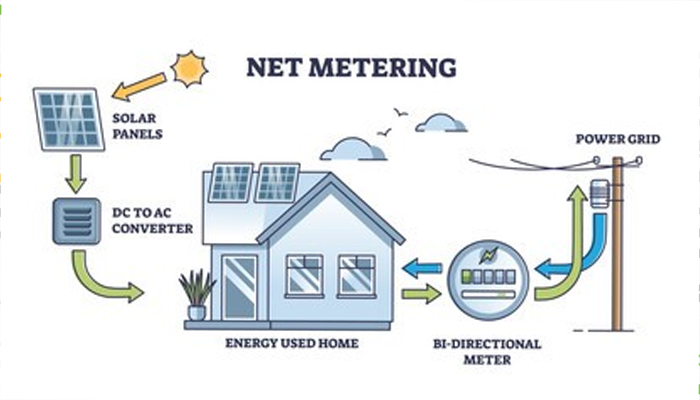
The landscape of renewable energy in Pakistan has faced a dramatic shift in February 2026.
The Great Debate: Net Metering vs. Net Billing
For nearly a decade, Pakistan operated under a net metering system.
The new net billing system, introduced on February 9, 2026, breaks this 1:1 parity.
-
Imports: You pay the full retail price (approx. Rs. 50–65 per unit) for electricity taken from the grid.
-
Exports: The grid buys your excess solar power at the National Average Energy Purchase Price (NAEPP), which is currently around Rs. 11–13 per unit.
This creates a significant "buy-high, sell-low" gap.
On February 12, 2026, Energy Minister Awais Leghari informed the National Assembly that Prime Minister Shehbaz Sharif has halted the transition for existing consumers.
-
Government Appeal: The Power Division has been directed to file a review appeal with NEPRA to protect the "contractual obligations" made to people who already invested millions in solar panels.
-
New Applicants: While existing users are shielded, new solar connections are expected to fall under the net billing regime, with contract lengths potentially reduced from 7 years to 5 years.
The government cites two primary reasons for the shift:
-
Financial Pressure: DISCOs claim they are losing billions in revenue as wealthier households go "off-grid" while the government still pays billions in "capacity charges" to private power plants (IPPs).
-
The Duck Curve: Massive solar generation at noon causes grid instability, while demand spikes sharply at sunset when solar panels stop working, forcing the grid to ramp up expensive fossil fuel plants instantly.
The Future: Rise of Hybrid Systems
With the uncertainty surrounding grid-buyback rates, many Pakistanis are now moving toward Hybrid Solar Systems. By adding lithium-ion battery storage, homeowners can store their own daytime surplus to use at night, reducing their dependence on the grid and making them immune to future "net billing" policy changes.
Summary Table: 10kW System Payback Comparison
| Feature | Old Net Metering (Existing) | New Net Billing (New Applicants) |
| Export Rate | Rs. 60 / unit (Variable) | Rs. 11 / unit (Fixed Avg) |
| Monthly Savings | Rs. 72,000 | Rs. 36,720 |
| Annual Savings | Rs. 864,000 | Rs. 440,640 |
| Break-Even Time | ~14 Months | ~27 Months |
The "Expert" Verdict
Even under the harsher Net Billing rules, the payback period is still roughly 2.3 years. In the global context, where payback periods often exceed 5–7 years, solar in Pakistan remains an incredibly lucrative investment because our grid electricity is so expensive.
However, to get the best ROI now, you should focus on Self-Consumption. The more electricity you use directly during the day (running ACs, pumps, etc.), the more you "save" at Rs. 60/unit instead of "selling" it for Rs. 11/unit.