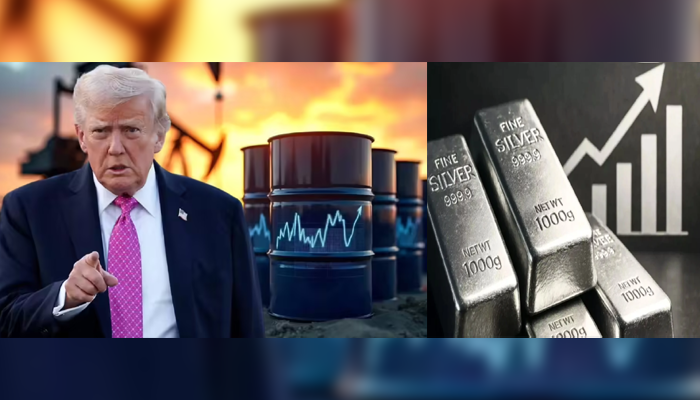
For decades, the global fascination with Venezuela oil crisis was fueled by its status as a petrostate holding the world’s largest crude oil reserves. However, the dramatic events of early January 2026 suggest that the "black gold" narrative may only be the surface of a much deeper, more metallic geopolitics explained strategic play. Following the stunning U.S. military operation that resulted in the capture of President Nicolás Maduro, President Donald Trump declared that the United States would "run" the country until a transition is finalized. While Trump publicly frames this as a mission to have "big oil companies" repair broken infrastructure and flood the market with cheap gasoline, a parallel $7.4 billion industrial maneuver suggests that the real 21st-century prize is not carbon— it is silver.
Beneath the headlines of the US-Venezuela conflict 2026 lies a monumental shift in US foreign policy. Just weeks before the intervention, the Trump administration, in partnership with JPMorgan and Korea Zinc, finalized a $7.4 billion smelter project to establish the "U.S. Smelter" in Tennessee. Notably, the Department of Defense holds a 40% stake in this venture, signaling that this is not a mere commercial project but a critical component of energy security and national defense. While the facility is designed to process zinc and copper, its capability to refine silver at scale is the linchpin. Venezuela is not just an oil giant; it is a repository of vast, largely unrefined critical minerals and precious metals. By taking control of Venezuelan assets, the U.S. has effectively secured a massive upstream supply for a downstream processing engine that aims to reduce dependence on China.
The timing of this "hidden war for silver" is no coincidence. In early 2026, China implemented aggressive new licensing restrictions on silver exports, threatening to choke the global supply of a metal essential for AI semiconductors, electric vehicle (EV) batteries, and defense systems. Silver is no longer just jewelry; it is a strategic material recently added to the White House’s priority list. Trump’s direct intervention in Venezuela provides a decisive answer to China’s export ban. By integrating Venezuela’s mineral-rich "Arco Minero" into the U.S. supply chain, the administration is attempting to build a "fortress economy" that is immune to Eastern trade embargoes and secures modern technology inputs.
For global markets and india oil imports, this move is transformative. While the immediate reaction in 2026 saw silver prices rally toward record levels due to geopolitical risk, the long-term play is about supply chain restructuring. If the U.S. successfully redirects Venezuelan raw ore to its domestic smelters, it creates a closed-loop system for clean energy and high-tech industries. This "supply chain depth" provides the kind of geopolitical leverage that world politics 2025 and 2026 have shown to be more valuable than oil alone. The traditional tools of diplomacy are being replaced by the hard reality of logistics; the nation that controls the smelter controls the future of international relations analysis.
Critics argue that the focus on oil is a populist smokescreen designed to win domestic support with the promise of lower pump prices, while the actual industrial policy focuses on resource imperialism. Trump’s rhetoric focuses on "fixing the oil" and "bringing the country back," but his administration’s actions—specifically the use of military assets to secure mining regions—tell a different story. The U.S. is not just looking for fuel to burn; it is looking for the conductive materials required to power the next industrial revolution and ensure strategic autonomy.
In this new era, the US takeover of Venezuela assets marks the end of the globalized, "just-in-time" mineral market. We have entered the age of "resource realism," where military strength is used to secure industrial inputs for EVs and defense. Whether Trump is motivated by crude oil supply or silver, the outcome is the same: the United States has signaled that it will no longer rely on hostile rivals for the materials that define modern power. The war for Venezuela’s future is being fought in the oil fields, but the war for the century's dominance is being won in the silver smelters.