
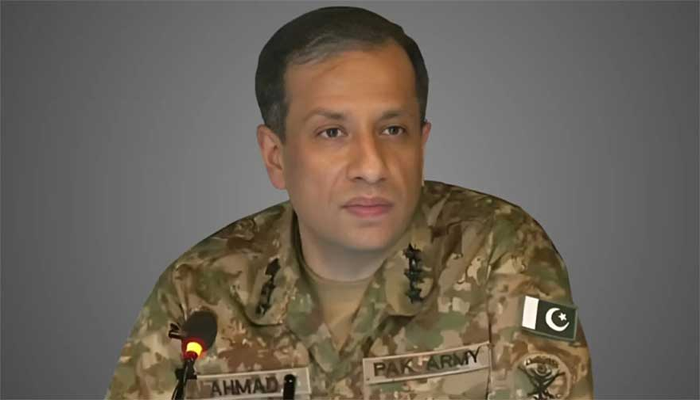
ISLAMABAD: Director General of Inter-Services Public Relations (DG ISPR) Lt Gen Ahmed Sharif Chaudhry on Thursday said India’s long-standing narrative of portraying Pakistan as a source of terrorism had been “buried forever” after the events of Marka-e-Haq.
Addressing a joint press conference alongside Deputy Chief of Naval Staff (Operations) Rear Admiral Shifaat Ali Khan and Deputy Chief of Air Staff (Projects) Air Vice Marshal Tariq Mahmood Ghazi, the DG ISPR highlighted the strategic consequences of Marka-e-Haq and Bunyanum Marsoos.
Lt Gen Ahmed Sharif Chaudhry said the international community now understands that Pakistan is not a perpetrator of terrorism but rather a victim of Indian-sponsored terrorism. He said India had attempted for decades to accuse Pakistan of involvement in terrorism without presenting credible evidence.
The DG ISPR stated that Pakistan emerged as a net regional security stabilizer during Marka-e-Haq. He said the operation reflected the vision of Quaid-e-Azam Muhammad Ali Jinnah, who envisioned Pakistan as a peace-loving country seeking stability within and beyond its borders.
He added that the world witnessed how India escalated tensions based on what he described as fabricated narratives, while Pakistan and its armed forces responded with maturity and restraint. According to the DG ISPR, the operation demonstrated Pakistan’s preparedness across conventional, cyber and information warfare domains.
Discussing the military dimension, Lt Gen Ahmed Sharif Chaudhry claimed Pakistan downed four Indian Rafale jets, one MiG-29, one Su-30, one Mirage 2000 and an unmanned aerial vehicle during Marka-e-Haq. He also remarked that Indian media spread misinformation during the conflict, including false claims regarding the capture of Lahore port.
The DG ISPR criticized what he called the politicization of the Indian military leadership and the militarization of Indian politics. He said Indian political leaders were promoting aggressive Hindutva and Akhand Bharat narratives, which he termed dangerous for regional peace.
He further alleged that India has been supporting proxy groups such as Fitna al-Khawarij and Fitna al-Hindustan to destabilize Pakistan. He described the alleged nexus between the Afghan Taliban and the Indian government as an “unholy alliance.”
According to the DG ISPR, terrorism incidents increased in Pakistan after Marka-e-Haq as India allegedly shifted towards proxy warfare following what he described as a “crushing defeat.” He said Pakistan later launched Operation Ghazab Lil Haq to counter India-sponsored terrorism.
Lt Gen Ahmed Sharif Chaudhry also highlighted the transformed nature of modern warfare, saying conflicts are no longer limited to borders or the Line of Control. He explained that warfare now extends to cyberspace, information operations and cognitive domains targeting public opinion and national morale.
He emphasized that Pakistan’s armed forces remain fully prepared to respond across all domains of warfare. The DG ISPR said Marka-e-Haq proved Pakistan’s resilience against both traditional and non-traditional security threats.
Referring to regional stability, he reiterated that there is no space for war between two nuclear-armed neighboring countries. He warned that any attempt to pursue conflict between nuclear states would amount to madness.
The DG ISPR concluded by saying the most significant outcome of Marka-e-Haq was the strengthened unity between the people, the government and the armed forces, which he called the “Bunyan um Marsoos effect.”