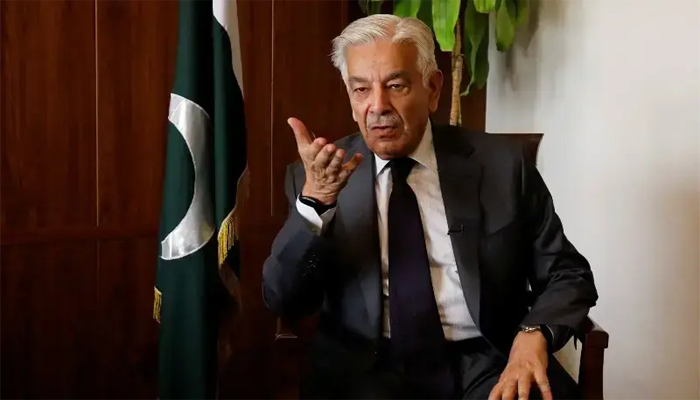

ISLAMABAD: Pakistan’s Defence Minister Khawaja Asif issued a stark warning to the Taliban government in Kabul on Wednesday, saying any attempt to test Islamabad’s resolve would be undertaken “at your own peril and doom.” The remarks followed the collapse of a fresh round of talks in Istanbul aimed at addressing cross-border terrorism, Pakistani officials said.
Asif, in a post on X, said Pakistan had tolerated what he described as treachery and mockery for too long and that further terrorist attacks or suicide bombings on Pakistani soil would invite severe retaliation. “Be rest assured and test our resolve and capabilities, if you wish so, at your own peril and doom,” he wrote.
The defence minister accused certain Afghan officials of making venomous statements that reveal a “devious and splintered mindset” within the Taliban regime. He added that Pakistan had agreed to dialogue at the request of friendly regional states, but diplomacy cannot continue in the face of persistent threats and inflammatory rhetoric.
Asif warned that Pakistan would not need to employ its full military arsenal to defeat the Taliban, saying Islamabad could “completely obliterate the Taliban regime and push them back to the caves for hiding.” He invoked historical imagery, referencing the rout at Tora Bora, and suggested a repeat would be “a spectacle to watch for the people of the region.”
He further accused the Kabul rulers of pursuing conflict to sustain a war economy and to retain power, saying their war cries were hollow yet aimed at bolstering a crumbling facade. “If the Afghan Taliban regime is madly hell-bent upon ruining Afghanistan and its innocent people once again, then so be it,” Asif said.
Addressing the oft-used phrase “graveyard of empires,” he said Afghanistan was not a graveyard for foreign powers but had become a graveyard for its own people and a playground for outside interests. He concluded that any fight with Pakistan would expose Taliban threats as merely a “performative circus.”
Washington and regional capitals urged restraint, while analysts warned that renewed hostilities would destabilise the wider region, complicating humanitarian assistance and cross-border trade for months ahead and economies.