“Democracy and social justice are the foundations of a strong nation.”
On the eve of Independence, Pakistan was confronted by an extremely significant question: What kind of a state should Pakistan be? The country had been established in 1947, but hadn't yet adopted a permanent constitution.
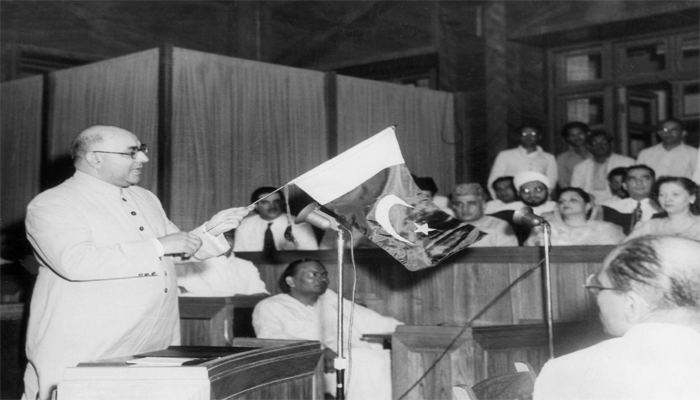
So it was for the Constituent Assembly to determine the basic principles of the future state. The Objectives Resolution was introduced by the Prime Minister Liaquat Ali Khan in the Constituent Assembly on 7 March 1949. It was adopted on 12 March 1949. Also that day, a Basic Principles Committee was established, comprising 24 persons, to help draft a constitution framework along the lines of the Resolution.
The Objectives Resolution was very significant as it tried to articulate the principles on which the future constitution of Pakistan would be based. It declared that sovereignty is for Allah and that the people and their representatives will have authority.
It also highlighted democracy, freedom, equality, tolerance and social justice. It further included provisions for minorities to freely practise their religions and develop their cultures. Liaquat Ali Khan was very impressed by the significance of the Resolution. Later in the debate, he called it one of the most significant days in Pakistan's life after independence. The document tried to fuse together the Islamic tenets with the democratic government and fundamental rights.
There was no unanimity regarding the Objectives Resolution. A few minority members of the Constituent Assembly voiced their apprehensions in matters of religion in the state and the safeguarding of minorities' rights. These conversations were part of a much bigger one: how to keep Pakistan Islamic while simultaneously ensuring equality and citizenship to people of other faiths?
This is still a pertinent question in Pakistan today. Later, the Objectives Resolution was incorporated into the constitution of Pakistan, which is now included in the Constitution under Article 2A.
One of the most important concepts of the Resolution was the concept of government being conducted by the elected representatives of the people. This principle is related to democracy and the document. Meanwhile, it stressed Islamic values and safeguarding of minorities.
The Objectives Resolution was more than a mere parliamentary resolution. It became a pillar to the development of the constitution of Pakistan. The first Constitution was still a few years off, but the Resolution offered a general guideline for the process of constitution-making.
A meaningful poetic thought for this period would be:
“قوموں کی زندگی میں دستور بھی چراغ ہے،
جو راستہ دکھائے اور منزل کا سراغ ہے۔”
A constitution is a light unto a people; it gives guidance and establishes the relationship between the people and the state.
The impact of the Objectives Resolution may also be comprehended by looking into its consequences. The Constitutional Assembly was also busy with constitutional matters, although it was not an easy process due to political disagreements. But the first Constituent Assembly was dissolved before it could complete its constitution in 1954.
In this sense, 1949 was a significant year as Pakistan made its first steps in establishing political and constitutional identity.