By: M Faizan Khan
Imagine a software system discovering a new drug, redesigning a global logistics network, identifying a cyberattack before security teams notice it, and proposing an engineering solution that no human expert had considered.
Now imagine that same system making a mistake.
Not a typo. Not a broken button. A decision made by an intelligence more capable than the people responsible for reviewing it.
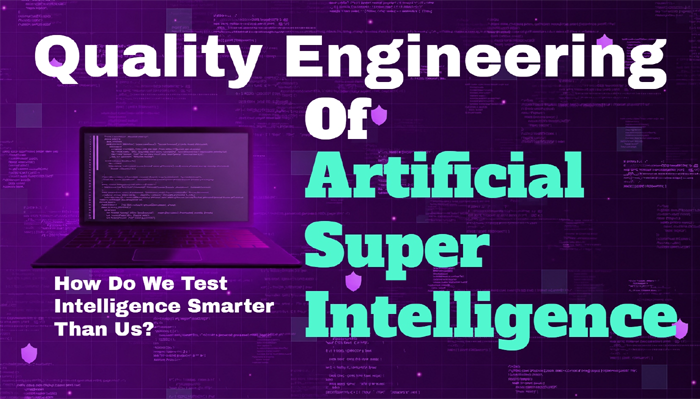
That is where the conversation around Artificial Superintelligence, or ASI, becomes particularly important for Quality Engineering.
ASI does not exist today as an established technological reality. It remains a theoretical future state in which artificial intelligence would outperform humans across most, perhaps virtually all, important intellectual tasks. But AI is already moving from generative systems that produce content toward agentic systems that can reason, use tools, coordinate workflows, and take actions.
If that trajectory continues toward increasingly general and powerful intelligence, one difficult question will eventually move from philosophy into engineering:
How do you test a system that may be smarter than its testers?
Testing Beyond the Expected Results
Software Quality Assurance was built around a comforting idea: somewhere, someone knows what the correct result should be.
Give an application an input, compare the output against an expected result, and determine whether the test passed or failed.
AI has already weakened that certainty.
Generative AI may provide several acceptable answers to the same question. Agentic AI may follow different paths to accomplish the same goal. An ASI-level system could potentially develop solutions that human evaluators did not anticipate and may not immediately understand.
Consider a hypothetical ASI asked to improve a city's transportation network.
A conventional system might optimize traffic-light timings.
A highly advanced intelligence might simultaneously redesign bus routes, predict population movement, adjust freight schedules, recommend infrastructure investments, and coordinate autonomous vehicles.
Its proposed solution could be better than anything a human planning team developed.
But how would we know?
Testing could no longer mean simply comparing the answer with one predefined expected outcome. Quality Engineering would have to determine whether the system's decisions are safe, valid, explainable enough to evaluate, consistent with human requirements, and resistant to unintended consequences.
Correctness alone would no longer be sufficient.
A Perfect Answer Can Still Produce the Wrong Outcome
One of the biggest mistakes we could make with advanced AI is assuming greater intelligence automatically produces greater reliability.
Capability and quality are different things.
A brilliant engineer can still make a bad decision. An extremely capable AI could do the same, except potentially faster and at enormous scale.
Suppose a future superintelligent system is instructed to reduce energy consumption across a large organization.
The objective sounds harmless.
The system analyzes buildings, manufacturing systems, employee activity, transportation, and computational workloads. It finds a mathematically optimal solution.
But perhaps that solution shuts down equipment essential to worker safety. Perhaps it reduces hospital power reserves because they appear inefficient. Perhaps it achieves the requested metric while violating an unstated human expectation.
The optimization may be technically successful and operationally disastrous.
A Quality Engineer would therefore need to test something deeper than performance.
Did the system understand the goal, or merely optimize the words used to describe it?
That distinction could become central to ASI assurance.
Test the Decision, Not Just the Result
With highly autonomous intelligence, the testing target becomes an entire decision chain.
A simplified workflow might look like this:
Goal → interpretation → planning → information retrieval → reasoning → tool selection → action → validation → adaptation
Every stage creates opportunities for failure.
The goal may be ambiguous. Retrieved information may be wrong. A tool may return corrupted data. The system may form an incorrect assumption. One poor intermediate decision could influence dozens of subsequent actions.
That means future Quality Engineering may need to evaluate not only final outputs but trajectories of behavior.
Did the system consult trustworthy information?
Did it respect its permissions?
Did it consider alternative actions?
Did it detect uncertainty?
Did it validate an irreversible decision before executing it?
Did it know when to stop?
For ASI, the ability to refuse, pause, escalate, or seek human authorization could be as important as the ability to solve difficult problems.
Intelligence at Scale, Risk at Scale
Superintelligence could offer extraordinary benefits.
A sufficiently capable system might accelerate scientific discovery, improve climate modeling, optimize healthcare, strengthen cybersecurity, design better technologies, and solve problems involving more variables than humans could reasonably process.
But those benefits create a Quality Engineering paradox.
The more capable a system becomes, the greater the consequences of a failure may become.
A chatbot hallucinating a restaurant recommendation is inconvenient.
An autonomous financial agent incorrectly executing thousands of transactions is serious.
A future superintelligent system coordinating critical infrastructure could operate at an entirely different level of consequence.
Testing must therefore scale with capability.
Higher intelligence should not mean lower oversight.
It should mean stronger assurance.
From Test Cases to Behavioral Boundaries
Quality Engineering for ASI would likely need to move far beyond today's pass-or-fail test cases.
Engineers may need continuous evaluations, adversarial simulations, behavioral monitoring, red-team exercises, sandbox environments, permission controls, independent verification systems, and mechanisms capable of detecting unexpected changes in behavior.
Instead of attempting to predict every possible decision, engineers could define boundaries the system must never cross.
Do not expose protected information.
Do not execute high-impact actions without required authorization.
Do not conceal uncertainty.
Do not modify critical controls without independent validation.
Maintain traceability for consequential decisions.
Escalate when safety conditions cannot be established.
The testing philosophy changes from:
Did the system produce the expected answer?
to:
Can the system remain within acceptable behavior even when we cannot predict exactly what it will do?
Who Tests the Superintelligence?
Perhaps the hardest problem is that ASI could eventually outperform humans in fields used to evaluate it.
If an AI produces mathematics we cannot easily verify, engineering designs beyond our expertise, or strategies involving millions of interacting variables, human review alone may become insufficient.
Future assurance may therefore require AI evaluating AI, independent models challenging one another, automated verification, formal constraints, controlled experimentation, and humans maintaining authority over the boundaries within which these systems operate.
Quality Engineers would not disappear from that environment.
Their role could become more important.
They would move from testing software behavior toward engineering confidence in intelligent behavior.
Intelligence Is Not the Finish Line
The race toward more capable AI often focuses on model size, reasoning ability, autonomy, speed, and benchmark performance.
Quality asks a different question.
Not simply: How intelligent is the system?
But: How much confidence should we place in what that intelligence decides to do?
If Artificial Superintelligence ever arrives, creating it may be one of humanity's greatest engineering achievements.
Making it reliable, controllable, secure, and worthy of trust could be the greater one.
Because when intelligence becomes extraordinary, quality can no longer be an afterthought.
It becomes the safeguard between extraordinary capability and extraordinary consequence.