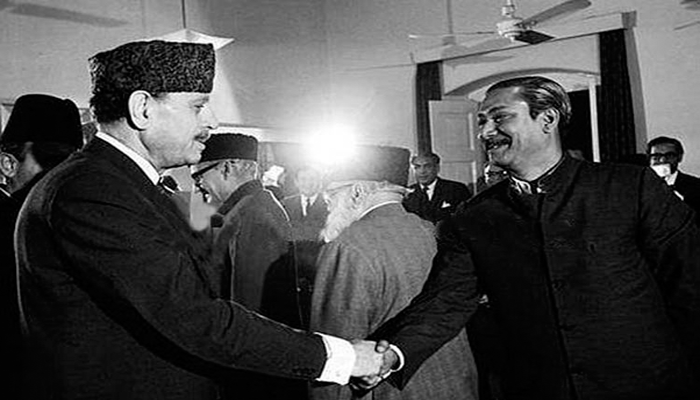
“Power is strongest when it is guided by responsibility.”
1958 marked the turning point of the political course of Pakistan. Years of political instability led to the end of Pakistan's first Constitution and the setting up of martial law, with the military at the heart of national political life.
On 7 October 1958, President Iskander Mirza abolished the constitution, suspended both the National Assembly and Provincial Assemblies and declared martial law. He made General Muhammad Ayub Khan Chief Martial Law Administrator and Army Commander-in-Chief. Twenty days later, on 27 October 1958, Ayub Khan declared Iskander Mirza removed and himself as President.
The political crisis had been a long time in the making. Since independence, Pakistan had been getting the change of governments often. There was a division of political parties, some unstable governments and slow constitutional development.
There had already been a parliamentary system provided for in the 1956 Constitution, which was unable to achieve political stability. The first general election was planned for early 1959, but due to the events of October 1958, this one was never held. Iskander Mirza thought that parliamentary politics had failed to give stability. But his declaration of martial law brought an end to Pakistan's initial experience of constitutional parliamentary democracy. Initially, Ayub Khan was made the Chief Martial Law Administrator, later the President of the country as well.
The shift was momentous because it set a precedent which was going to affect the politics of Pakistan for decades to come—the direct involvement of the military in political government. Ayub Khan served as president for over a decade in Pakistan's early history, from 1958 till 1969. Ayub Khan thought that the country had to be reformed politically and administratively. He later proposed a new political model, called Basic Democracies.
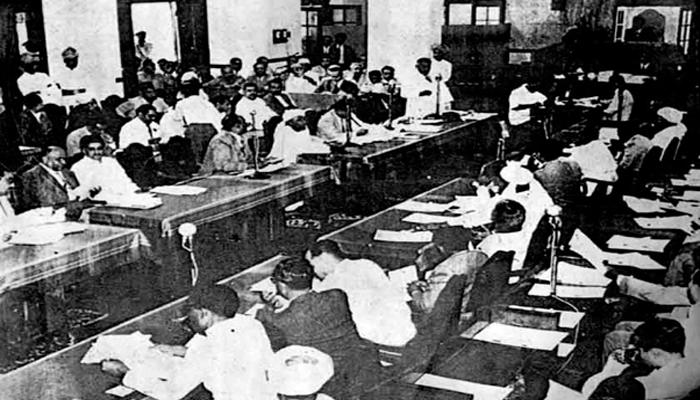
Direct elections to the parliament were not introduced at once, but rather the establishment of local government bodies and an electoral college. According to the historical record of the National Assembly, the electoral college comprised some 80,000 Basic Democrats, between 40,000 and 45,000 from each portion of Pakistan.
Ayub Khan also tried to establish a new constitutional system. In February, 1960, he constituted a Constitution Commission to examine the process of strengthening and adaptation of democracy in the socio-political environment of Pakistan. The Commission presented its report in April 1961. This, in turn, resulted in the Constitution of 1962.
During the Ayub era, economic and industrial growth followed. The construction of large development projects, the growth of industries and new infrastructure were undertaken. But with the expansion of the economy, issues of unequal wealth distribution and regional disparities arose. The economic and political power was still considered to be with West Pakistan by many in East Pakistan.
The change in 1958 was also a big one for the ordinary people of Pakistan in terms of political culture. The notion that the Defence Department could play a direct role in government took hold. This would have repercussions beyond the tenure of Ayub Khan.
Allama Iqbal's poetry reminds us that a nation's strength depends on more than authority:
“نہیں ہے ناامید اقبال اپنی کشتِ ویراں سے
ذرا نم ہو تو یہ مٹی بہت زرخیز ہے ساقی”
Iqbal's message is of hope that with effort and a change of heart, even the toughest challenges can be overcome.
Ayub Khan's adherents considered him to be a moderniser and a stabiliser in the kingdom. He was criticised for the disempowering of democratic institutions. Both points of view are significant in the study of the period. History is not a simple matter of "all good, all bad" or "all bad, all good. The major takeaway from 1958 is that political unrest can lead to authoritarian solutions, and that these solutions have a long-term impact.
Democracy is hard, slow and time-consuming; so are good political institutions. The events of 1958 were thus a turning point. Pakistan shifted from Parliamentary Democracy to its first-ever period of military dictatorship.