
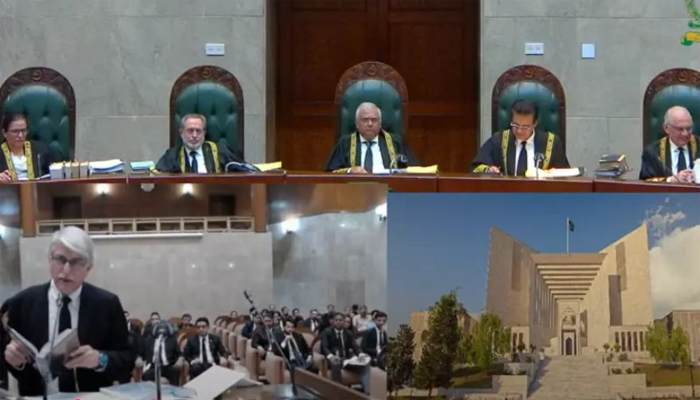
ISLAMABAD: Justice Muhammad Ali Mazhar remarked on Tuesday that the Supreme Court’s regular and constitutional benches (CBs) were “branches of one tree” as an eight-member CB continued hearing petitions challenging the 26th Constitutional Amendment.
Passed during a controversial overnight parliamentary session in October last year, the 26th Amendment has stirred intense debate. The PTI, which opposed the legislation, alleged that seven of its lawmakers were abducted to secure votes in its favour. Similarly, the Balochistan National Party-Mengal (BNP-M) claimed two of its senators faced pressure before ultimately backing the amendment against party lines.
The amendment made significant changes to the judiciary’s structure and authority. It curtailed the Supreme Court’s suo motu powers, fixed the chief justice’s tenure at three years, and introduced a Special Parliamentary Committee to appoint the CJP from the top three senior judges. Notably, it also established the constitutional benches now hearing the petitions challenging the very amendment that enabled their creation.
Tuesday’s hearing was presided over by Justice Aminuddin Khan and included Justices Mazhar, Mandokhail, Ayesha Malik, Rizvi, Hilali, Afghan, and Shahid Bilal Hassan. Retired Justice Shabbar Raza Rizvi concluded his arguments, while Dr. Adnan Khan, representing petitioner Anas Ahmed, also presented his case. The bench adjourned the hearing until 11:30am Wednesday.
During arguments, Justice Mandokhail challenged Rizvi’s position, asking if the bench retained suo motu powers independently of the Supreme Court. Rizvi maintained that while the CB had received certain powers via the amendment, none were taken from the apex court.
Justice Musarrat Hilali pointed to Article 191A, introduced by the amendment, asking whether seeking a full bench meant reverting to pre-amendment procedures. “How can Article 191A be bypassed?” she questioned.
Rizvi responded that Article 191A should be interpreted in conjunction with the Constitution’s broader framework, arguing that it had not nullified the Supreme Court’s jurisdiction under Article 184(3).
The case continues to raise constitutional questions about judicial independence and the separation of powers.