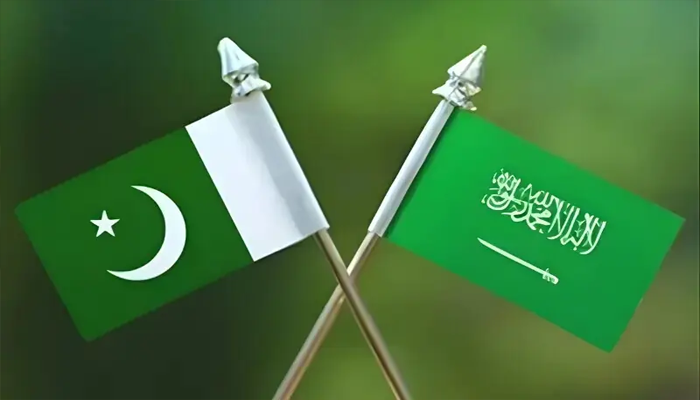

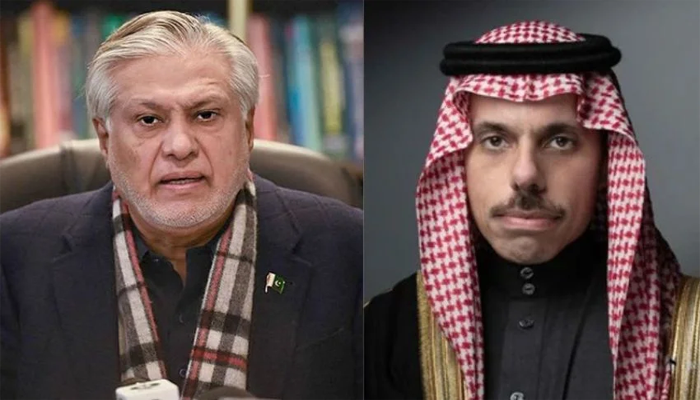
ISLAMABAD: Deputy Prime Minister and Foreign Minister Senator Ishaq Dar held a telephone conversation with Saudi Foreign Minister Prince Faisal bin Farhan on Tuesday to discuss the rapidly evolving regional situation, as tensions in the Middle East intensify following Saudi Arabia’s military strikes in Yemen.
According to a statement issued by the Foreign Office, the two leaders exchanged views on the prevailing regional environment and shared their assessments of recent developments. The contact took place at a time of heightened uncertainty, with concerns growing over the potential implications of the Yemen conflict and emerging rifts among key Gulf allies.
During the call, Senator Ishaq Dar conveyed Season’s Greetings and extended his best wishes for the New Year to Prince Faisal bin Farhan. The Saudi foreign minister warmly reciprocated the gesture, reflecting the cordial and longstanding relationship between Pakistan and Saudi Arabia.
The Foreign Office said the deputy prime minister expressed satisfaction over the positive trajectory of bilateral relations between the two countries. He reaffirmed Pakistan’s commitment to further strengthening cooperation with Saudi Arabia across multiple sectors, including diplomacy, trade, investment, and regional coordination. Dar also underscored Pakistan’s consistent support for peace, dialogue, and stability in the Middle East.
Prince Faisal bin Farhan, in response, reiterated Saudi Arabia’s desire to enhance and deepen its ties with Pakistan. He emphasized the importance of continued high-level engagement and close coordination between the two countries on regional and international matters. The discussion highlighted the shared interest of Islamabad and Riyadh in promoting stability, security, and peaceful conflict resolution in the region.
The diplomatic contact came amid a significant escalation in Yemen, where Saudi Arabia launched airstrikes targeting what it described as a weapons shipment linked to the United Arab Emirates and destined for the Southern Transitional Council (STC), a separatist group operating in southern Yemen. Riyadh stated that the strikes were aimed at safeguarding its national security, which it described as a red line.
Tensions between Saudi Arabia and the UAE, once regarded as close allies and key partners in regional security, have intensified in recent weeks. Their differences have reportedly widened over issues such as geopolitical influence, Yemen policy, and oil production strategies within the OPEC alliance. Saudi Arabia on Tuesday backed calls for UAE forces to withdraw from Yemen within 24 hours, using some of its strongest language yet against Abu Dhabi.
Meanwhile, Yemen’s Saudi-backed presidential council head, Rashad al-Alimi, announced the cancellation of a defence and security pact with the UAE. He accused Abu Dhabi of fueling internal instability by supporting the STC, which has recently made territorial gains in southern Yemen. Al-Alimi claimed that the UAE had pressured and directed the separatist group to challenge the authority of the Yemeni state through military escalation.
Saudi Arabia said that coalition airstrikes targeted vehicles and weapons unloaded at the port of Mukalla from ships that reportedly arrived from the UAE port of Fujairah without authorization. Saudi state media released footage showing damaged military vehicles, while AFP visuals from the port showed several burnt-out vehicles following the strikes.
The UAE, however, rejected Saudi Arabia’s allegations, stating that the shipment in question did not contain weapons and that the vehicles unloaded were not intended for any Yemeni faction. Despite the denial, Riyadh described Abu Dhabi’s actions as highly dangerous and warned it would take all necessary measures to protect its national security.
The developments have raised concerns about a possible renewed civil war in Yemen, as the STC advances against Saudi-supported government forces, breaking years of relative stalemate. The group claims control over large parts of southern Yemen, including the strategic Hadramout province, defying Saudi calls for withdrawal.
Despite the rising political and military tensions, global oil markets remained relatively stable. Brent crude futures for February delivery rose modestly, trading above $62 per barrel, while US West Texas Intermediate also posted small gains. Analysts said investors were closely monitoring the situation, particularly given the roles of Saudi Arabia and the UAE as major players in the OPEC oil exporters’ group.
Against this complex backdrop, the conversation between Pakistan and Saudi Arabia underscored Islamabad’s continued diplomatic engagement with key regional partners and its emphasis on dialogue and stability during a period of growing geopolitical uncertainty.