
ISLAMABAD: United Nations experts have raised serious legal and human rights concerns over India’s military actions inside Pakistan following the April 22 Pahalgam attack in Indian-administered Kashmir, as well as New Delhi’s unilateral move to place the Indus Waters Treaty in abeyance.
A detailed report by UN Special Rapporteurs, dated October 16 and made public on December 15, concludes that India’s actions appear to violate international law, undermine Pakistan’s sovereignty, and threaten the fundamental rights of millions of civilians.
According to the report, the April 22 attack in Pahalgam, which killed 26 civilian tourists, triggered a sharp escalation between the two nuclear-armed neighbours. India blamed Pakistan for the assault without presenting publicly verifiable evidence. Pakistan denied any involvement and questioned the credibility of India’s claims, calling them fabricated and politically motivated. Despite the lack of substantiated proof, India launched missile strikes inside Pakistani territory on May 7, escalating tensions into the most serious military confrontation between the two countries in decades.
The UN experts stressed that international law does not recognise a separate right for states to use unilateral military force in foreign territory for counterterrorism purposes. They noted that India failed to notify the United Nations Security Council that its actions were taken in self-defence under Article 51 of the UN Charter, a procedural requirement for any lawful claim of self-defence. In the absence of such notification and credible evidence linking the attack to Pakistani state involvement, the experts concluded that India’s actions appear to constitute an unlawful use of force under Article 2(4) of the UN Charter.
The report warns that such actions violate Pakistan’s sovereignty and may amount to an armed attack, potentially entitling Pakistan to exercise its own right of self-defence. The experts cautioned that unilateral military actions without legal justification significantly increase the risk of wider escalation, posing grave dangers to civilian lives in both countries.
UN experts also expressed alarm over reports that Indian strikes caused civilian casualties and damage to populated areas and religious sites, including mosques. They said this raises serious concerns about violations of the right to life under the International Covenant on Civil and Political Rights, as well as the protection of civilian infrastructure during armed conflict.
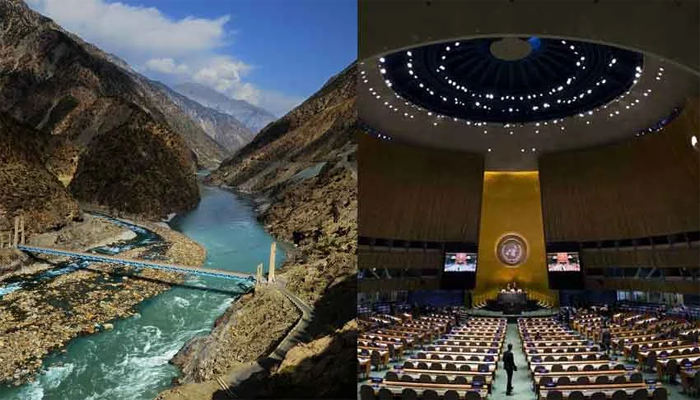
Beyond military action, the report dedicates significant attention to India’s decision to hold the Indus Waters Treaty in abeyance. Signed in 1960 and brokered by the World Bank, the treaty governs the sharing of the Indus River system, allocating the western rivers Indus, Jhelum and Chenab primarily to Pakistan. The experts highlighted that these rivers irrigate around 80 percent of Pakistan’s arable land and are essential for food security, livelihoods, drinking water, and economic stability for a population of about 240 million.
The report warns that any disruption to river flows, whether through dam operations, sediment release, or reduced downstream supply, could severely impact human rights in Pakistan, including the rights to water, food, health, work, an adequate standard of living, and a clean and sustainable environment. The experts noted that Pakistan is already one of the world’s most water-stressed and climate-vulnerable countries, making uninterrupted river flows even more critical.
The UN experts said there appear to be no valid legal grounds under international treaty law for India’s unilateral suspension of the Indus Waters Treaty. Even if countermeasures were considered, they stressed that such actions must be proportionate, temporary, and must not affect fundamental human rights. They added that India had not fulfilled procedural requirements such as providing notice or offering negotiations before taking such steps.
The report also linked recurring tensions over water and cross-border violence to the unresolved dispute over Kashmir, stating that long-term stability is unlikely without a peaceful settlement in accordance with international law and the right to self-determination.
In response, President Asif Ali Zardari welcomed the UN report, saying it reinforced Pakistan’s long-standing position that the unilateral use of force across international borders violates the UN Charter and undermines regional and global peace. He described the findings on civilian harm and water security as deeply troubling and urged the international community to take note of what he termed India’s increasingly aggressive and destabilising behaviour.
The UN experts have asked India to respond to six key questions, including whether it will provide reparations for loss of life, fulfil its treaty obligations in good faith, prevent further harm to civilians, and pursue peaceful dispute resolution mechanisms. While awaiting India’s reply, they urged immediate steps to halt alleged violations and prevent their recurrence, warning that continued disregard for international law could have far-reaching consequences for regional stability and human rights.