
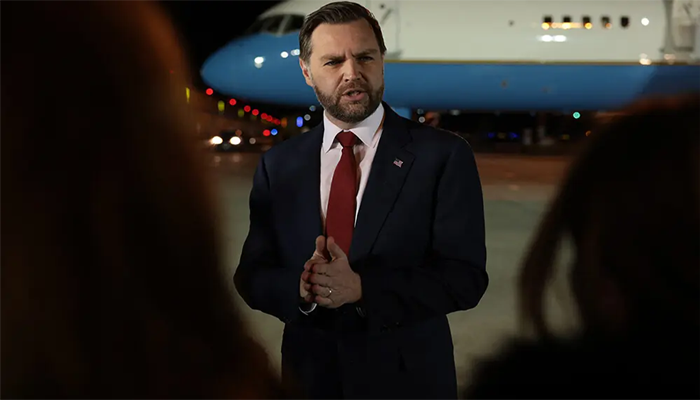
WASHINGTON DC: US Vice President JD Vance said yesterday that the ceasefire agreement reached between the United States and Iran does not include Lebanon, despite Iranian officials believing otherwise.
Speaking to reporters in Budapest, Vance said Tehran’s negotiators appeared to misunderstand the terms of the agreement reached on Tuesday.
“I think this comes from a legitimate misunderstanding. I think the Iranians thought that the ceasefire included Lebanon, and it just didn’t,” Vance said.
According to the US vice president, Washington’s position from the start was that the truce would only apply to Iran and American allies, including Israel and the Gulf Arab states.
The clarification comes amid growing confusion over whether Lebanon would be included in the US-Iran ceasefire announced earlier this week.
Iran had suggested that a halt in fighting in Lebanon was linked to its support for the ceasefire. Iranian President Masoud Pezeshkian said earlier that a Lebanon ceasefire was one of the key conditions in Iran’s 10-point plan to end the broader Middle East conflict.
However, Vance’s comments directly contradict earlier remarks by Pakistani Prime Minister Shehbaz Sharif, who played an important role in the diplomatic talks between Washington and Tehran.
Sharif had indicated that the ceasefire would also cover Lebanon, where tensions remain high between Israel and the Iran-backed Hezbollah group.
Despite excluding Lebanon from the agreement, Vance said Israel had shown willingness to reduce military activity in the country in order to support the broader peace process.
“The Israelis, as I understand it, have actually offered to check themselves a little bit in Lebanon, because they want to make sure that our negotiation is successful,” Vance said.
Israel has continued military operations in Lebanon even after the US-Iran truce came into effect. Israeli officials maintain that Lebanon is not part of the current agreement.
The uncertainty has increased fears that fighting between Israel and Hezbollah could continue, threatening the fragile ceasefire and raising the risk of a wider Middle East war.