
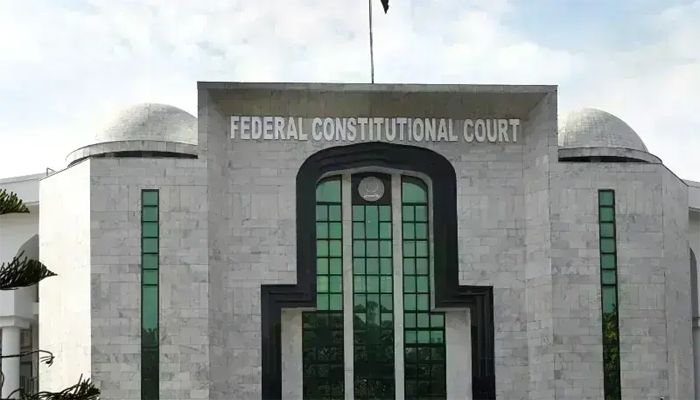
A three-member bench, headed by Chief Justice Aminuddin Khan and comprising Justice Syed Hasan Azhar Rizvi and Justice Syed Arshad Hussain Shah, heard arguments from several senior lawyers representing major companies and taxpayers.
The earlier judgement had declared that Parliament was constitutionally empowered to impose, abolish, amend or regulate taxes through a Finance Act under Article 73(2)(a) of the Constitution.
Several prominent companies, including Fauji Fertiliser Company, Engro Corporation, JS Bank, Colgate-Palmolive Pakistan, Pakistan Refinery and Total Parco Pakistan, have challenged the ruling.
During Monday's hearing, counsel for the petitioners argued that Section 4C of the Income Tax Ordinance was unconstitutional and should be struck down. Alternatively, they requested the court to declare that the provision did not apply to tax year 2022 or income subject to final taxation.
The lawyers also challenged the retrospective imposition of Super Tax through the Finance Act 2022, arguing that the legislation took effect on July 2, 2022, after the relevant tax year had already ended. They maintained that businesses had closed their accounts, held annual general meetings and distributed dividends under the existing tax framework.
The petitioners argued that imposing additional tax liability retrospectively was arbitrary and violated constitutional protections under Articles 10A, 18, 23 and 24.
Introduced by the PML-N government in 2015, Super Tax applies to wealthy individuals, associations of persons and companies earning more than Rs500 million. The tax rate stands at four per cent for banking companies and three per cent for other sectors.
The levy was originally introduced to generate funds for rehabilitating temporarily displaced persons.
The petitioners also questioned the exclusion of brought-forward losses, depreciation and amortisation from tax calculations, arguing that such measures effectively imposed income tax on losses and expenses.
After hearing detailed arguments, the FCC reserved its decision. The forthcoming ruling could have significant implications for major businesses and Pakistan's taxation framework.