

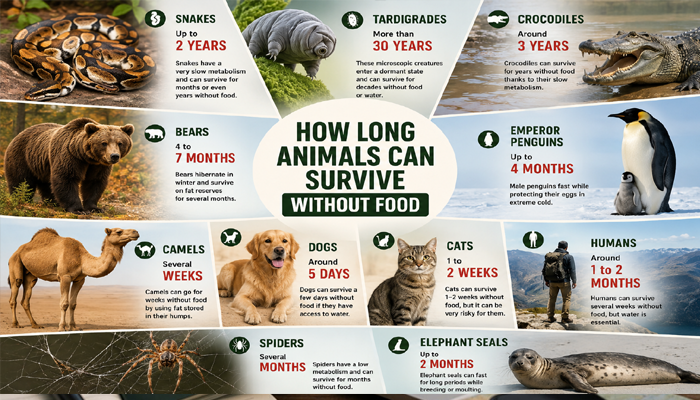
The ability of animals to survive without food varies dramatically across species. While humans can typically survive for several weeks without eating under ideal conditions, many animals have evolved extraordinary adaptations that allow them to endure months—or even years—without a meal.
These survival strategies depend on several factors, including metabolism, body fat, environmental conditions, water availability, and evolutionary adaptations. Some animals slow their metabolism to conserve energy, while others rely on stored fat or enter dormant states like hibernation.
Here's a closer look at how long different animals can survive without food and the remarkable biological mechanisms that make it possible.
1. Snakes: Up to Two Years
Snakes are among the world's most efficient fasting animals. Certain species, particularly pythons and vipers, can survive for up to two years without eating under suitable conditions.
Unlike mammals, snakes have extremely slow metabolisms. After consuming a large meal, they digest it gradually and convert much of the energy into fat reserves. During long fasting periods, they reduce their metabolic rate by as much as 70%, allowing them to conserve energy remarkably well.
This adaptation helps snakes survive during seasons when prey is scarce.
2. Tardigrades: More Than 30 Years
Although microscopic, tardigrades—often called "water bears"—are among the toughest organisms on Earth.
When food and water become unavailable, they enter a dormant state known as cryptobiosis, nearly shutting down all biological activity. In this state, they can survive for decades, with scientists estimating survival periods exceeding 30 years under laboratory conditions.
Once moisture returns, they resume normal life almost immediately.
3. Crocodiles: Around Three Years
Crocodiles can survive up to three years without food, especially after consuming a large meal.
Their cold-blooded nature means they require significantly less energy than warm-blooded animals. During food shortages, crocodiles become less active and rely on stored fat while dramatically slowing their metabolism.
This ability allows them to withstand prolonged droughts and seasonal changes.
4. Bears: Four to Seven Months
Bears survive long periods without food during hibernation.
Depending on the species and climate, bears can go four to seven months without eating, drinking, urinating, or defecating.
Before winter, bears consume massive quantities of food to build fat reserves. During hibernation, their heart rate drops significantly, body temperature decreases slightly, and metabolism slows, allowing stored fat to provide all necessary energy.
5. Emperor Penguins: Up to Four Months
Male emperor penguins endure one of nature's toughest fasting challenges.
While incubating eggs during Antarctica's harsh winter, males remain on the ice without food for approximately 115 to 120 days.
Throughout this period, they rely entirely on fat accumulated before breeding while protecting their eggs from freezing temperatures.
6. Camels: Several Weeks Without Food
Camels are famous for surviving harsh desert conditions.
Although they are better known for surviving without water, healthy camels can also live several weeks without food, depending on environmental conditions.
Contrary to popular belief, their humps do not store water—they store fat. This fat is converted into energy when food is unavailable, enabling camels to travel long distances across deserts.
7. Dogs: Around Five Days
Domestic dogs generally survive three to five days without food, though healthy dogs with access to water may survive for up to a week or longer.
Veterinarians warn that prolonged fasting can quickly lead to muscle loss, organ damage, and weakened immunity. Any dog refusing food for more than 24–48 hours should be examined by a veterinarian.
8. Cats: One to Two Weeks
Cats can survive one to two weeks without food, provided they continue drinking water.
However, they face a unique risk called hepatic lipidosis (fatty liver disease). This life-threatening condition can develop after only a few days of not eating, making prolonged fasting particularly dangerous for felines.
9. Humans: Around One to Two Months
Humans typically survive 30 to 60 days without food, depending on hydration, body fat, health status, and environmental conditions.
Water is far more critical than food. Without adequate hydration, survival often drops to only a few days.
Medical supervision is essential during any prolonged fasting period.
10. Spiders: Several Months
Many spider species can survive two to six months without food.
Their low metabolic rate allows them to conserve energy efficiently while waiting patiently for prey. Some cave-dwelling spiders have been observed surviving even longer in nutrient-poor environments.
What Determines How Long Animals Can Go Without Food?
Several biological factors influence fasting survival:
-
Metabolic rate: Animals with slower metabolisms require less energy.
-
Body fat: Stored fat serves as the primary energy reserve.
-
Body temperature: Cold-blooded animals generally survive longer than warm-blooded species.
-
Activity level: Reduced movement conserves energy.
-
Water availability: Hydration is often more important than food.
-
Environmental conditions: Cooler temperatures usually reduce energy requirements.
Why Can Cold-Blooded Animals Fast Longer?
Reptiles, amphibians, and many fish are ectothermic, meaning they rely on external temperatures to regulate body heat.
Because they don't need to generate constant body heat like mammals and birds, they expend much less energy, allowing them to survive much longer without food.
This explains why crocodiles, snakes, and some turtles can fast for months or even years.
The Role of Hibernation and Dormancy
Many animals survive food shortages by entering periods of dormancy.
Hibernation, estivation, torpor, and cryptobiosis all reduce metabolism dramatically, enabling animals to conserve energy until conditions improve.
These survival mechanisms have evolved over millions of years and represent some of nature's most remarkable adaptations.
Final Thoughts
Nature demonstrates extraordinary diversity in survival strategies. While domestic animals like dogs and cats can only tolerate short periods without food, reptiles such as snakes and crocodiles can survive for years thanks to their slow metabolism. Hibernating bears, fasting emperor penguins, and microscopic tardigrades each showcase unique evolutionary adaptations that allow them to endure prolonged food shortages.
Understanding these remarkable abilities not only highlights the resilience of wildlife but also underscores the importance of preserving natural habitats that sustain these species. As climate change and habitat loss continue to affect ecosystems worldwide, studying animal survival strategies has become increasingly important for conservation and wildlife management.