KARACHI : LAAM Fashion Week (LFW) closed the second edition of LFW Presents tonight in Karachi with Kaleidoscopic Karachi, a five-designer runway showcase staged inside the historic Nusserwanjee Building at the Indus Valley School of Art and Architecture (IVS).
The evening brought together Deepak Perwani, Wardha Saleem, Khaadi, The Pink Tree Company and Sana Safinaz, and opened with an archival exhibition by photographer Tapu Javeri. It was the format’s first edition outside Lahore.
Kaleidoscopic Karachi was built around a simple idea: that Karachi does not read as a single image. Across the evening, the five presentations moved between the polished and the artisanal, the historic and the contemporary, the glamorous and the craft-first. Together, they read as a portrait of the city in fragments, and of a fashion industry that has never needed to sound like one voice to speak with authority.
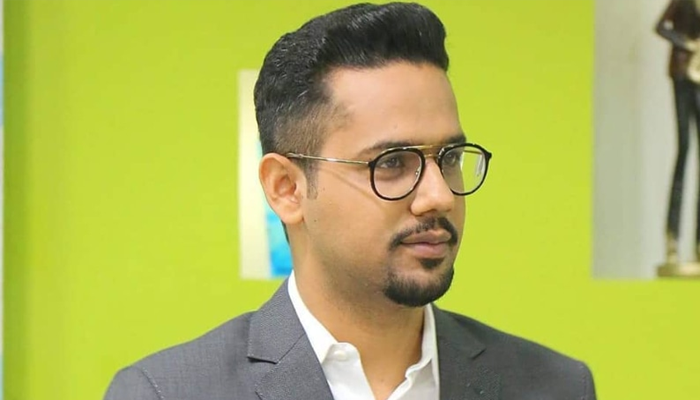
Speaking at the event, Saad Ali, CEO & Founder of Design651 and Co-Founder of LAAM Fashion Week, highlighted the importance of having an ecosystem of fashion and the decision to bring it to Karachi.
“A brand-led Pakistan cannot be built inside two runway weeks a year. It needs a year-round ecosystem where designers, brands and craftspeople are given the room, the settings and the audiences to build lasting equity,” Saad said. “That is what LFW Presents was created to do, and Kaleidoscopic Karachi is the format doing exactly that outside Lahore for the first time. When Pakistani fashion is placed inside a venue that holds the city’s own story, and given the industry weight it deserves, its impact reaches far beyond a single evening. That is the standard we intend to hold to for every edition.”
The evening opened with Tapu Javeri – A Four-Decade Fashion Retrospective, an immersive exhibition drawn from the archive of one of Pakistan’s most influential fashion photographers and defining visual chroniclers of Karachi. Spanning decades of Pakistani fashion and the city around it, the exhibition set the tone for the runway that followed, tracing the visual memory of Karachi’s fashion history through Javeri’s lens.
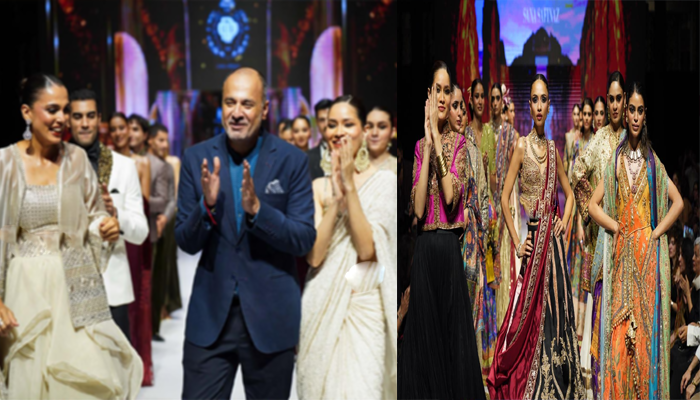
The runway then came alive with the presentations and the grand finale. Deepak Perwani’s Cocktail Hour opened the evening as an ode to the historic glamour of Karachi. The clubs, the after-hours, the sensuality the metropolis embodied through the mid-1970s. Perwani translated that memory through svelte silhouettes, sparkle, glitter and an alluring capsule that dressed the city’s past for its present. In a moment that landed as pure Karachi legacy, supermodels of the 80s, Frieha Altaf, Seemi Pasha and Atiya Khan, walked the collection as a living tribute to the era it celebrated.
Wardha Saleem followed with Bander Road Se Kemari, a tactile, street-alive reading of the city. The collection paid ode to centuries of Karachi’s architecture: colonial buildings and their balconies, regal motifs, the quiet grandeur of monuments woven into the city skyline. Hip, streetwear-adjacent and modern-luxe in feel, Saleem’s work carried the built city onto the body, turning cornice, arch and facade into cut, drape and print. Actress, model, and the showstopper for the collection, Areeba Habib, walked the runway in elegance, draped in a stunning gold and green lehenga!
The Pink Tree Company, a craft-based luxury brand, presented Hands That Craft, a homage to Karachi and to the crafts that built the country’s fashion industry. The collection brought together textile, block print, dye, embroidery, gota and kaamdani, a bouquet of artistries carrying millennia of human excellence into a single runway moment. The showstopper, Aliya Iqbal Naqvi, graced the runway in a colorful lehenga! Staged inside Nusserwanjee, itself a feat of the city’s creative minds, the presentation read as a case for the hand: for craft that no technology can imitate or replace, and for a city that refuses to be subdued.
Khaadi presented Karachi – It’s Complicated, a collection built on the dichotomies the city is known for: the love and the hate, the chaos and the quiet. The tension translated literally onto the runway through contrasting colours, woven fabrics and stark, raving prints. The collection’s showstopper and model, Eman Suleman, walked the runway in a striped black and white top with colorful embellishment and a black flowy skirt with pink floral print. Chapter 2 flowed into the presentation, bringing Khaadi’s designer language into direct conversation with its street-facing energy.
Together, the four presentations revealed the many visual languages of the city — its colour, contradiction, craft and constant reinvention. For Maheen Kardar, Executive Director Designer Experience and Curation, LFW Presents, that was precisely the point of bringing Kaleidoscopic Karachi to life:
“We are all here today for one thing and that is fashion. This time, LFW Presents a conversation with the city that I love and hold close to my heart. Karachi for us is the city in which so much of the industry was born. This is where so much of the fashion resides. It is love, it is layered, and it is endlessly generous! It is truly a Kaleidoscope; and this is what we are seeing on the runway tonight.”
The finale closed with Sana Safinaz’s Mastaani, the label’s high-end luxury couture and festive line, walked by 20 models. Regal, avant-garde silhouettes met traditional heritage and modern aesthetic in equal measure. Fluid drapes, couture lehengas and statement pieces carried a quiet, graceful rhythm across the runway! Model Javeria Hanif, and also the showstopper for the finale collection walked the ramp draped in a black veil, wearing a heavily embellished gold blouse, paired with a stunning black lehenga and a red dupatta, closing the evening with the cinematic weight the collection was built for.
Off the runway, the evening drew an equally dynamic crowd, bringing together some of the city’s most recognisable names from fashion, entertainment, media and the creative industries. Celebrities, fashion icons, designers, stylists, influencers and socialites mingled with digital and news media, corporate leaders and members of government. Among those in attendance were Bunto Kazmi, Faiza Samee, Fahad Mirza, Gohar Rasheed, Iqra Aziz, Kamiar Rokni, Kubra Khan, Nadia Hussain Parishae Adnan, Saniya Maskatiya, Sarwat Gillani, Shehla Chatoor, Sharmila Faruqui, Sonya Battla, Zainab Chotani, Zainab Qayyum and more, adding to a room that reflected the breadth, influence and cultural pulse of Karachi’s creative scene.
“Every LFW moment has the technology, marketplace and cross-border logistics built into it. It is the innovation that has helped us created this into a shoppable, discoverable, exportable experience for customers across more than 120 countries. LFW Presents also is not just a runway format for us. It is another surface through which Pakistani fashion is introduced to a global consumer, and the next phase for LAAM, and for the businesses on it, is outward: more cities, more markets, more borders crossed for the designers we work with,” said Amir Iqbal, Co-Founder & COO of LAAM and Co-Founder of LAAM Fashion Week.
The setting was every bit as considered as the fashion. The Nusserwanjee Building at IVS, one of Karachi’s most evocative architectural landmarks, became a meeting point between the city’s past and its ever-changing present. Steeped in Parsi heritage and originally built in Kharadar, the historic structure was carefully dismantled, its stones carried across the city and rebuilt piece by piece at the IVS campus by the school’s architecture students, giving a fragment of old Karachi another life in a new setting. Against its walls, the evening’s fashion carried an added weight: a collision of Karachi’s past and present held inside a single room.
“LFW was built to change what a fashion week can be in this part of the world. Technology sits at the heart of that: the same personalisation, data and content engine that powers LAAM is what turns a runway night in Karachi into a global content moment, into shoppable inventory, into cultural IP that can travel. Kaleidoscopic Karachi is proof that when you bring product, technology and creative direction into the same room, you do not just host a fashion week. You rewrite what one is capable of. That is the space LFW is changing,” said Arif Iqbal, Co-Founder & CEO of LAAM and Co-Founder of LAAM Fashion Week.
Kaleidoscopic Karachi leaves behind more than a showcase of memorable looks. It leaves behind a portrait of a city that keeps changing its shape: glamorous one moment, gritty the next, rooted in heritage and always evolving. And a format, in LFW Presents, that has proved it can travel.