
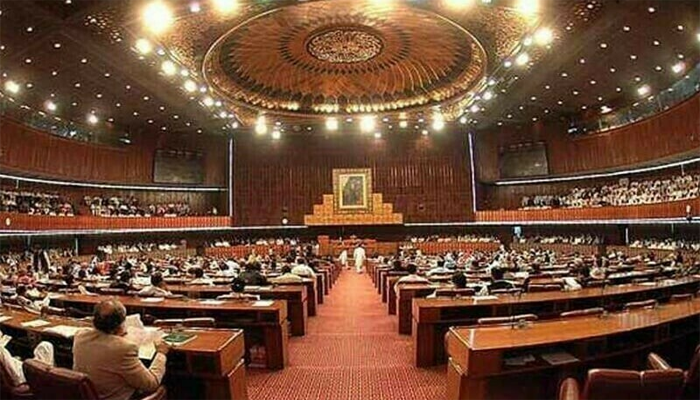
ISLAMABAD: The National Assembly on Wednesday approved 31 demands for grants totaling Rs4.814 trillion, rejecting all 430 cut motions filed by opposition members. These grants, part of the 136 total demands for the upcoming fiscal year, cover key ministries and divisions including Finance and Revenue, Human Rights, Interior, and National Food Security and Research.
The move came ahead of the scheduled passage of the Finance Bill 2025 on Thursday. During debate sessions held over two days, opposition parties fiercely criticized the budget and the government’s economic policies.
Leader of the Opposition Omar Ayub termed the budget “dead on arrival,” condemning the government’s economic management. He accused officials of the Federal Board of Revenue (FBR) of widespread corruption, alleging collusion with smugglers and tax evaders. “Every year, oil worth Rs550 billion is smuggled from Iran using around 72,000 18-wheeler trucks,” he claimed.
Ayub also challenged the government’s claims of reduced inflation, saying that purchasing power continues to shrink, with nearly 44 percent of the population now living below the poverty line. He held the PML-N government responsible for increasing capacity payments to independent power producers (IPPs) from Rs450 billion to Rs2,200 billion between 2013 and 2018 due to “unfair contracts.”
Other opposition lawmakers echoed these sentiments. JUI-F’s Aliya Kamran raised concerns about tax evasion and FBR's lack of accountability. PTI’s Shandana Gulzar accused the government of manipulating economic data and enacting anti-people policies.
Responding to the opposition’s criticism, Finance Minister Muhammad Aurangzeb defended the budget, highlighting improvements in the economy. He pointed to rising foreign exchange reserves, falling inflation, and a cut in the policy rate. He added that recent surveys indicated increased confidence among businesses and investors.
Aurangzeb also noted that federal spending in the next fiscal year would increase by less than two percent — a sharp contrast to previous years when expenditures rose by up to 13 percent. He emphasized that FBR reforms were underway, focusing on digitisation to increase transparency.
Minister of State for Interior Talal Chaudhry said that new security features had been added to Pakistani passports and that artificial intelligence systems at ports ensured travelers could not leave the country with fake documents.
Human Rights Minister Azam Nazeer Tarar announced that the National Commission for Human Rights had received an “A” rating from international watchdogs for the first time. He also cited improved legislation to protect vulnerable groups.
Agriculture also featured in the session, with Minister Rana Tanveer Hussain outlining steps to modernize the sector. He said fertilizer supply would be ensured and prices monitored. Deregulation of wheat and sugarcane pricing would help farmers get better market rates, he added.
Hussain confirmed the country is on track to produce 10 million bales of cotton and noted that 1,000 agricultural graduates have been sent to China for advanced training to enhance productivity.