By: Muhammad Faizan Khan
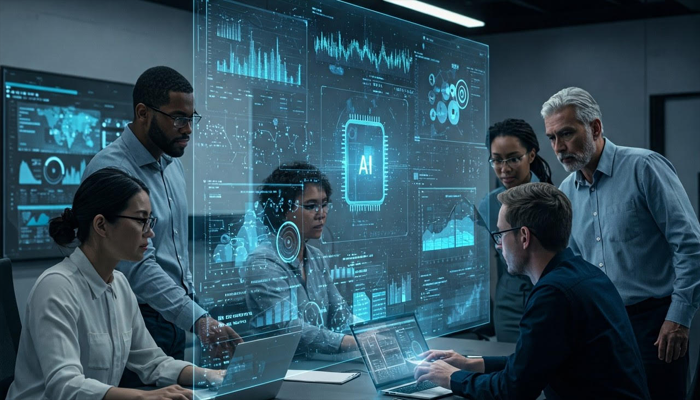
In a world gridlocked by supply chain snarls, trade imbalances and rising geopolitical tensions, artificial intelligence may be the most strategic diplomat in the room.
The New Merchant Class
For centuries, global trade was powered by gut instinct and rudimentary data: ship logs, commodity charts and rumors carried in coffee houses. Today, trade remains essential but the information landscape has grown too dense for human cognition alone. Enter artificial intelligence. It is a new merchant class that doesn’t sleep, doesn’t guess and isn’t afraid to rethink the rules.
AI isn’t just enhancing trade. It is transforming it. From predicting shipping bottlenecks to optimizing tariff strategies, machine learning models are surfacing in places once reserved for boardroom strategy or bureaucratic negotiation. The invisible hand of the market is now increasingly guided by an algorithmic one.
Untangling the Global Supply Chain
Let’s begin where the pain is most acutely felt: the global supply chain. The pandemic exposed just how brittle the system had become. Containers piled up in the wrong ports. Factories sat idle waiting on parts. Supermarket shelves went bare for reasons that even seasoned analysts struggled to explain in real time.
Artificial intelligence has stepped in not as a panacea but as a powerful new tool. Organizations such as Flexport and FourKites are applying artificial intelligence (AI) to help anticipate spikes in demand, plan for distribution interruptions caused by weather, and change the routing of shipments in real time. A 2022 McKinsey report found businesses that used AI-enabled supply chain management had forecasting error reductions of as much as 50 percent, and if stock-outs drove lost sales, those were reduced by as much as 65 percent. These aren’t marginal gains. They are existential ones.
AI’s ability to fuse disparate datasets such as satellite imagery, customs filings and historical demand curves gives it a predictive edge that human analysts can’t match. In a system where a single delayed shipment can ripple across continents, such foresight is not just helpful. It is revolutionary.
Trade Policy Turbocharged
Beyond logistics, AI has also begun influencing trade at the policy level. Governments are using AI to simulate the effects of new tariffs or sanctions not in years or months but in hours. Consider the EU’s implementation of carbon border taxes. This is a complex policy move requiring real-time data on emissions, import origins and trade volumes. Traditional models would take weeks to update. AI models, fed by real-time satellite and customs data, can recalibrate instantly.
These tools are also being used to detect illicit trade. Machine learning is identifying fraudulent trade invoices, routing anomalies and even patterns in money laundering through import-export firms. In a world where roughly 2 to 5 percent of global GDP is laundered annually according to the UN, AI could become a crucial weapon in the fight against financial crime.
From Humans to Hybrids
Of course, AI isn’t replacing human trade negotiators, logistics managers or analysts. It is augmenting them. The real opportunity lies in hybrid intelligence. These are systems where humans and AI collaborate, not compete.
Behavioral science tells us that humans are prone to cognitive biases under uncertainty. Loss aversion, availability bias and groupthink often lead to suboptimal trade decisions. AI doesn’t suffer from these flaws. It can offer data-backed alternatives in moments when instinct alone might falter.
In high-stakes negotiations, for example, AI-powered language models can parse legal texts across jurisdictions, summarize trade agreements and even flag clauses with historical enforcement issues. That is not a substitute for diplomacy but it is a silent partner in making it smarter.
The Ethical Ledger
And yet, amid the promise, there is peril. Algorithms reflect the data they are trained on and trade data is rife with historical inequities. An AI system trained on decades of trade patterns may inadvertently reinforce imbalances between rich and poor nations. There is also the growing concern about surveillance. Tracking shipments is one thing. When AI begins tracking human behavior within supply chains, especially in developing nations, the line between efficiency and exploitation begins to blur.
Transparency, accountability and inclusive design must be built into AI systems from the start. Just as we have globalized trade, we must globalize the ethics that govern it.
A Future of Frictionless Trade?
In the end, the future of AI in trade isn’t just about faster shipping or smarter tariffs. It is about creating a global system that is more resilient, equitable and responsive. A system that doesn’t just react to crisis but anticipates and adapts.
If AI can help us predict a port shutdown weeks in advance or detect when a trade agreement is likely to fail before it is even signed, then it is not just a tool. It is a compass. And in a world as economically interconnected as ours, a better compass might be the most critical infrastructure of all.
The writer is a Lead Software Quality Assurance Engineer and Project Manager. With proven expertise and research in AI, Agile and Software Quality. Passionate about delivering high-quality software products through best practices and standards. He is an emerging technologies enthusiast and writer, passionate about exploring the frontiers of artificial intelligence and its impact on society.