

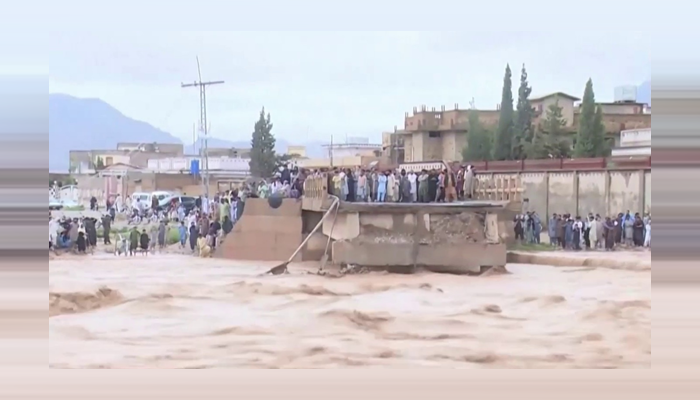
When the mighty rivers of Punjab turned into roaring oceans, they swallowed not just homes and fields but also the fragile hope of millions."
The food basket of Pakistan, Punjab, is experiencing the worst floods ever. Massive farmlands have become a sea due to heavy rains by monsoons aggravated by climate change and the release of water at once the world's border. The areas that were used to produce wheat, rice, and sugarcane are submerged in water, and there are millions of people who are in crisis due to their inability to survive in this crisis. Never before in history have the three great rivers of Punjab, the Chenab, Ravi, and Sutlej, all been three-quarters of an inch above dangerous levels simultaneously. At Ganda Singh Wala, the Sutlej River went on record at 261,000 cusecs, which was an extremely high flood never witnessed before. This year, the monsoon was 26.5 per cent heavier than last year, and this heavy, sudden increase broke dams, embankments, and drainage systems. Pakistan is unprepared towards such emergencies, and this disaster has shaken the lives of ordinary people.
Man is in great distress. Over two million of the population in Punjab have been affected, and almost a million people have been forced to leave their homes in one of the biggest evacuations in the history of Pakistan. Families, having to go along with the clothes on their backs, have been crowded into temporary camps. Some are standing on roofs and in trees to be rescued. And the floods are just too numerous as the army, the rescuers, and NGOs are working around the clock. And in Punjab, at least 33 persons have been killed, and the number of deaths in this monsoon nationwide has already passed 800. It is much more than the destruction of homes. More than 1400 villages are submerged, and almost 300,000 of the crops are destroyed. Punjab, which supplies most of the country, is now a risk of a food shortage in the next few months. Even livestock has drowned in large numbers, leaving poor farmers with no source of income. Economists predict that the losses may cost billions of rupees, and this will hit Pakistan at a time when the economy is already weak and inflation is high.
There is also an increase in health concerns. Sewage has been mixed with dirty, stagnant water, which has provided ideal conditions for diseases such as diarrhoea, malaria, cholera and skin infections. Families which are crowded together in a single shelter are under even greater threat, with thousands of them. Children are the most vulnerable, doctors say, since many of them are already malnourished. Damaged roads find hospitals that are overrun with patients, and they are having difficulty coping. The infrastructure in this province is destroyed. Bridges and roads have fallen down, and whole villages are isolated. Flight operations were forced to be cancelled at Sialkot Airport when the floodwater reached the runway. Many districts have ceased to have trains. To rescue large cities such as Lahore and Multan, the authorities have had to open embankments and divert water to the villages- an action that has invited fury among the villages, who feel betrayed due to the safety of their cities.
The politics too has gone into the crunch. Chief Minister Maryam Nawaz and top leaders have commended the relief efforts, and they have described them as unprecedented. However, as critics claim, the poor planning, the inadequate drainage, and uncontrolled constructions along the water channels aggravated the flooding. In cities such as Lahore or Sialkot, clogged drains converted heavy rain into urban floods. Meanwhile, Pakistan has criticised India for claiming to release the dam without sufficient warning, aggravating the downstream crisis. The floods are thus not only a humanitarian crisis, but also a political and diplomatic crisis.
Experts caution that these floods did not occur once. Even though Pakistan is a major contributor of less than 0.1 per cent of global emissions, it is one of the countries that is most susceptible to climate change. Since the colossal floods of 2010, the trend is apparent, with extreme weather hitting the country more frequently and violently since then, as the 2022 debacle flooded a third of the territory. So such tragedies can only intensify without the country investing in disaster planning, water management, and climate resilience. Foreign assistance is very important, yet domestic changes are also urgent.
Yet, even in this darkness, stories of human strength shine through. Shumaila Riaz, a 19-year-old, 7 months pregnant girl, had been trapped in her village in one camp and was rescued after two days. Volunteers took her to safety and took care of her. In Punjab, neighbours are sharing boats, food and shelter. Organisations such as Alkhidmat Foundation have recruited thousands of volunteers to deliver medicine and food to the needy. There is a spirit of unity that is more powerful than any flood that is keeping hope alive. It will be a long journey to recovery. It will take years to rebuild houses, replant fields and repair roads. The lessons of this calamity should not be overlooked, though. To be able to cope with the future floods, Pakistan requires better embankments, urban planning, equitable water contracts, and community education. The waters will ultimately subside, and it only remains to be seen whether the country will learn some lessons out of this crisis.
Punjab is bruised and not broken today. Its inhabitants are scarred people who will not surrender. The floods have shown up some of its weaknesses, but also some of its courage. And with the waters slowly receding, one fact is evident: that the struggle and endurance of Punjab is not yet at an end.
"As Punjab slowly rises from the waters, the true test lies in whether we rebuild stronger walls—or stronger communities."
By Tooba:
MBA, M.Phill