
By: Muhammad Faizan Khan
As generative AI reshapes how we access information, we must ask: is instant accuracy worth the erosion of discovery?
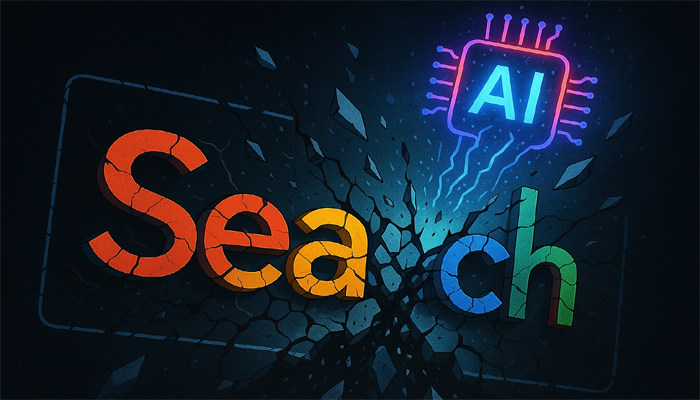
The internet has been a vast frontier for many decades, Google was the compass. You typed in a question, fumbled through links and gradually gathered understanding. Now, a new kind of information oracle has entered the scene: the AI answer engine. ChatGPT, Perplexity, Claude, Gemini, they don’t just help you search, they answer. The difference might sound semantic. It isn’t. Search engines give you choices. Answer engines give you conclusions. This change, although first takes little notice, marks a significant shift in the way we think, learn and trust information.
From Curator to Narrator
Search engines were curators. You’d get ten blue links and make your own path. The algorithm offered relevance but not certainty. With AI, the experience is frictionless. You pose a question, vague, precise, philosophical, absurd and receive a clean, synthesized response. No sifting, no tab-hopping, no mental triangulation.
Convenient? Incredibly. But also potentially corrosive. A recent study by Stanford’s Institute for Human-Centered AI found that over 60% of Gen Z users now prefer conversational AI over traditional search for educational queries. Not because it’s more accurate, it’s not always but because it “feels” smarter. This shift reveals more about us than the technology: we’re gravitating toward confident narration over exploratory thinking.
The Psychology of the Single Answer
Human cognition wasn’t designed for infinite choice. Barry Schwartz’s “Paradox of Choice” illustrated how too many options can paralyze us. AI answer engines seem like the antidote: they reduce the cognitive load by collapsing complexity into digestible authority.
But the speed of answers may come at the cost of intellectual humility.
When we used search engines, we lived in a state of “informational in-between.” We questioned sources, compared perspectives, bumped into contradictions. AI answer engines simulate that process but behind the curtain. The user sees only the end product, not the scaffolding. This introduces a troubling asymmetry, the AI knows how it got there. You don’t.
Truth Has Never Been This Efficient
Answer engines are trained on vast swaths of human text. They average it, condense it and serve it back to us with eerie fluency. But when truth becomes an average of past statements, we risk reinforcing stale paradigms, institutional biases and ideological loops.
Take medical queries. A chatbot might synthesize existing literature and respond with a summary that sounds definitive. But medical science is full of nuance, ongoing debate and outliers. If an AI says, “X is the best treatment,” how do we know whether that’s a consensus, a statistical median, or simply a linguistic artifact? Google at least made you click on PubMed or the Mayo Clinic. The AI might just skip the citation entirely.
The Disappearing Path to Knowledge
There’s a behavioral cost here that’s harder to quantify. Search engines taught a generation how to verify, contrast and trace. Answer engines risk producing information consumers instead of knowledge builders.
Even tech-savvy users report a kind of cognitive atrophy: a reliance on AI to not just supply answers but to ask better questions for them. In a way, we’re outsourcing not just search but curiosity itself.
This is not a Luddite lament. The gains are real: accessibility for the disabled, speed for the busy, simplicity for the overwhelmed. But as we embrace this new paradigm, we must build counterbalances, transparency tools, citation layers, explanation modes. Otherwise, we’ll trade agency for efficiency.
From Answers Back to Questions
If search was about exploration and AI is about resolution, perhaps the next evolution must focus on explanation. A middle ground where AI systems expose their reasoning, acknowledge uncertainty and empower users to dig deeper, not just accept what’s presented.
Because in a world increasingly defined by synthetic certainty, the most radical act might be to say: “Show me how you got there.”
The internet was designed as a place to wander. Let’s not let convenience take it from being a place of arriving.